On this page (16)
- What Is Live Message Translation?
- Why Live Translation Is No Longer Optional for Global Businesses
- Ecommerce is inherently international
- Hiring multilingual agents for every market isn't realistic
- Customers trust brands that "speak their language" literally
- Response speed still matters, even across languages
- How Live Translation Works Inside an AI Live Chat Platform
- Practical Use Cases for Live Message Translation
- International Customer Support
- Multilingual Sales Conversations
- Marketplace and Multi-Region Sellers
- Reducing Miscommunication in Order Issues
- What to Look for in a Live Translation Feature
- How to Roll Out Live Translation on Your Website
- Frequently Asked Questions About Live Message Translation
- Final Thoughts
Every business that sells beyond its home market eventually runs into the same wall: a customer messages in a language your support team doesn't speak. Maybe it's a Spanish-speaking shopper on a US-based store, or a French customer emailing a UK support inbox. Without a solution, one of two things happens the conversation stalls while someone scrambles to find a translator, or the customer gets a garbled, awkward reply from a basic translation tool and loses confidence in your brand.
Live message translation solves this problem by translating chat messages in real time, in both directions, so your agents can type in their own language while the customer reads (and writes) in theirs. This post covers how it works, why it matters more than ever for ecommerce and support teams, and how KonnectBot builds this directly into its AI live chat platform.
What Is Live Message Translation?
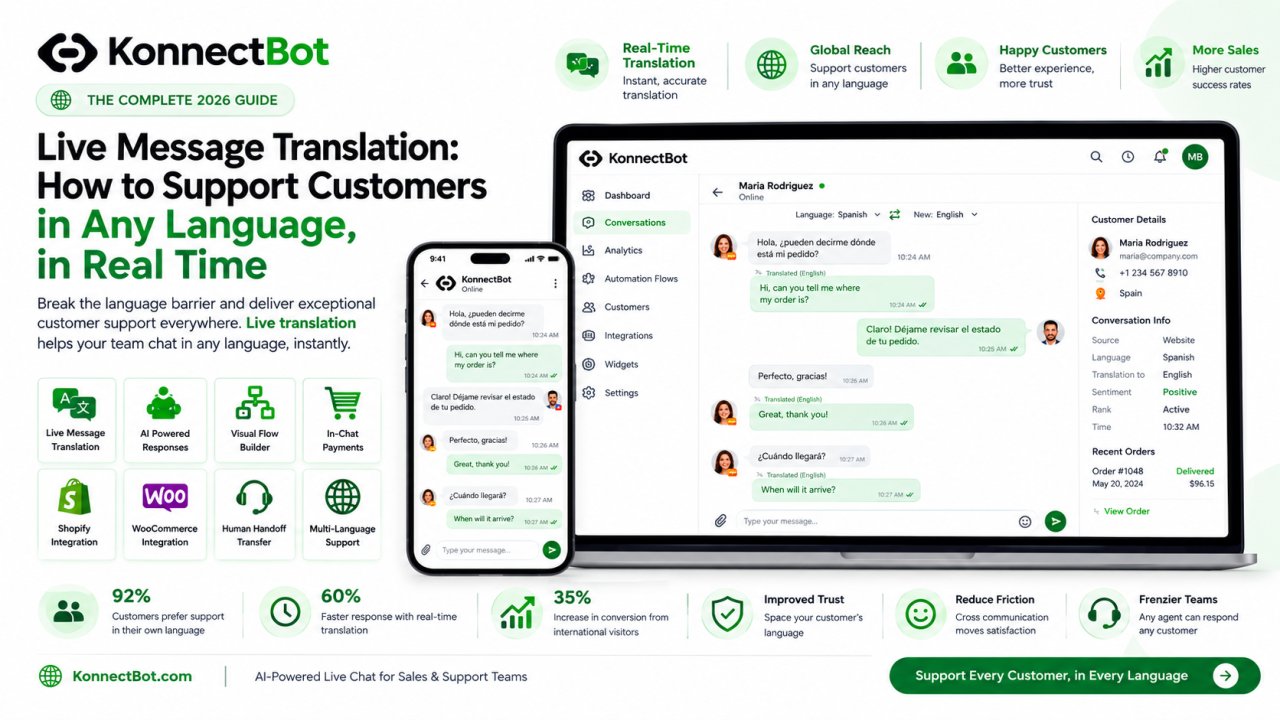
Live message translation is a feature that automatically translates chat messages as they're sent, allowing two people who don't share a language to have a natural conversation. Unlike copying a message into a separate translation tool, switching tabs, and pasting the result back, live message translation happens inside the chat window itself instantly, with no extra steps.
For a support agent, this means:
-
A customer types a message in Portuguese.
-
The agent sees it instantly translated into English (or whatever language they've set).
-
The agent replies in English.
-
The customer sees the reply instantly translated back into Portuguese.
Neither person has to leave the conversation, and neither has to trust a clunky machine translation tool to get the tone right on their own.
Why Live Translation Is No Longer Optional for Global Businesses
Ecommerce is inherently international
Once a store is online, it's reachable from anywhere. Even businesses that never intended to "go global" often find a meaningful percentage of their traffic and sales coming from customers who don't speak the store's primary language.
Hiring multilingual agents for every market isn't realistic
Staffing a support team with native speakers in every language your customers use is expensive and often impossible for small and mid-sized businesses. Live translation gives you the reach of a multilingual team without the multilingual hiring.
Customers trust brands that "speak their language" literally
Research on international ecommerce consistently shows that shoppers are far more likely to complete a purchase, and far more likely to trust a support interaction, when it happens in their native language. A translated storefront alone isn't enough if support conversations still happen in broken English.
Response speed still matters, even across languages
Without live translation, a support ticket in an unfamiliar language often gets deprioritized or routed to whoever happens to speak that language, adding delay. Live translation means any available agent can respond immediately, regardless of the customer's language.
How Live Translation Works Inside an AI Live Chat Platform
When translation is built directly into an AI live chat tool rather than existing as a separate app it can work alongside the other pieces of your customer conversation stack:
With AI-powered responses: the AI can understand and respond to a question in the customer's language automatically, without needing a human agent at all for common questions.
With automation flows: a visual flow builder can detect the customer's language and route the conversation accordingly for example, escalating non-English conversations to a specific agent group, or simply relying on live translation so any agent can respond.
With ecommerce data: order status, shipping information, and product details can be translated in real time, so a customer asking "cuándo llega mi pedido?" gets an accurate answer about their order, translated into Spanish, pulled directly from your Shopify or WooCommerce store.
This is exactly how KonnectBot approaches translation not as a bolt-on feature, but as a core part of the AI live chat experience, working together with automation and ecommerce integrations.
Practical Use Cases for Live Message Translation
International Customer Support
A support team based in one country can serve customers worldwide without hiring for every language. An agent in Karachi, London, or New York can handle a conversation with a customer in Berlin, Tokyo, or São Paulo without missing a beat.
Multilingual Sales Conversations
Sales teams handling inbound chat from international visitors can qualify leads, answer product questions, and close deals in the visitor's own language, dramatically improving conversion rates for non-native-English-speaking traffic.
Marketplace and Multi-Region Sellers
Businesses selling across multiple regions through Shopify or WooCommerce often see traffic from a dozen or more countries. Live translation means every one of those visitors gets support in their own language, without needing a region-specific team.
Reducing Miscommunication in Order Issues
Order problems wrong sizes, delayed shipments, damaged items are already stressful for customers. Adding a language barrier on top makes it worse. Live translation ensures these sensitive conversations are handled clearly, reducing frustration and negative reviews.
What to Look for in a Live Translation Feature
Not all "translation" features are created equal. Here's what actually matters:
-
Real-time speed. Translation should happen instantly within the chat, not require refreshing or manual triggering.
-
Two-way translation. Both the agent's and the customer's messages should be translated, not just one direction.
-
Context awareness. Good translation tools understand ecommerce and support-specific phrasing (shipping terms, product names, order statuses) rather than producing overly literal, robotic translations.
-
Integration with automation. Translation should work inside your existing chat flows, not as a separate disconnected tool your agents have to switch to.
-
No added complexity for agents. Agents shouldn't need any special training to use it it should just work inside the chat window they already use every day.
How to Roll Out Live Translation on Your Website
-
Identify your top non-English traffic sources. Check your analytics for the countries and languages generating the most visits and sales.
-
Enable live translation in your chat platform so any agent can respond to any customer, regardless of language.
-
Update your automation flows to include multilingual greetings or automatic language detection.
-
Train agents on tone, not language. Since translation handles the language itself, focus agent training on maintaining a warm, clear tone that translates well.
-
Monitor translated conversations for accuracy, especially around product names or technical terms specific to your business.
-
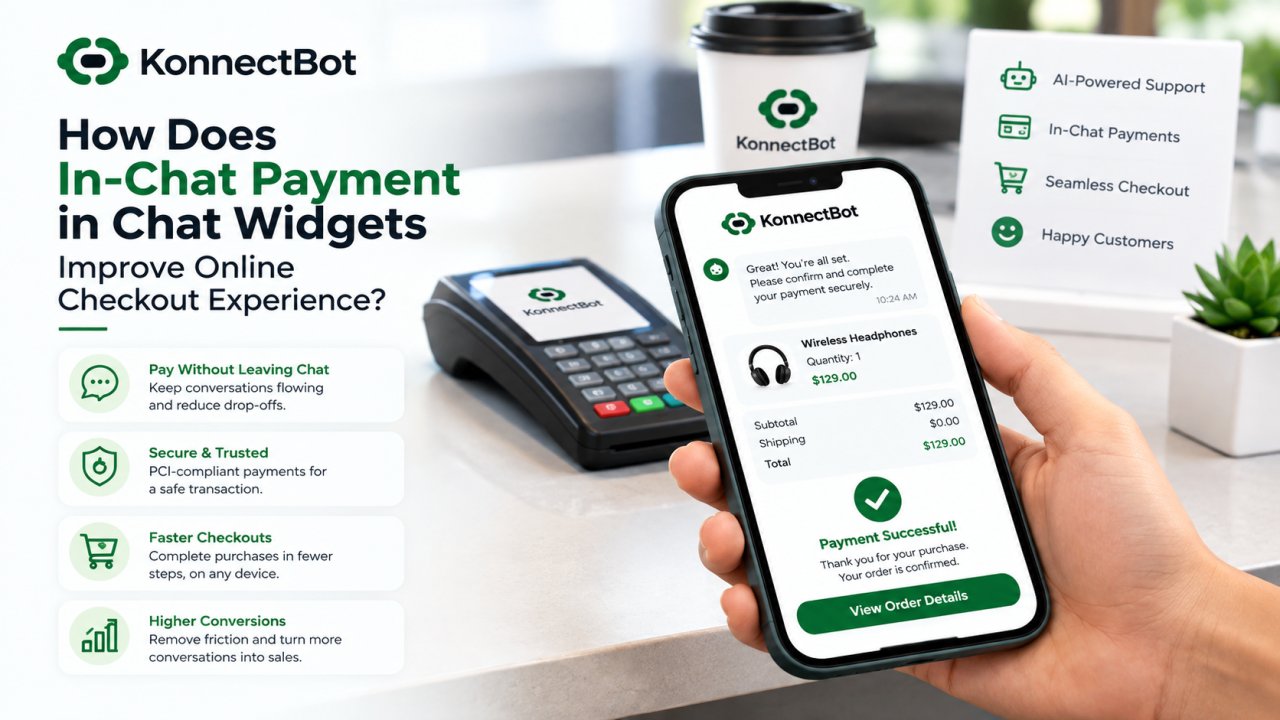
Combine with in-chat payments so international customers can complete a purchase directly in the conversation, in their own language, without friction.
Frequently Asked Questions About Live Message Translation
How accurate is live chat translation for ecommerce conversations?
Modern live translation, especially when built into a platform designed for ecommerce and support, handles common phrasing around orders, shipping, and products well. Reviewing translated transcripts occasionally is still a good practice, especially for industry-specific terminology.
Do agents need to learn a new tool to use live translation?
No. Good implementations, including KonnectBot, keep translation inside the same chat window agents already use there's no separate app or extra step required.
Does live translation work for both chat and messaging apps?
Yes, when the AI live chat platform supports omnichannel messaging. As KonnectBot expands into Facebook and Instagram, live translation extends to those channels as well, not just the website widget.
Can live translation work alongside AI-automated responses?
Absolutely. The AI can detect a customer's language, respond automatically in that language for common questions, and hand off to a human agent with translation still active for anything more complex.
Is live translation only useful for large, multinational companies?
No. Even a single support agent serving customers in one additional language can benefit significantly, since it removes an entire category of missed or delayed conversations.
Final Thoughts
Language shouldn't be the reason a sale is lost or a support ticket goes unresolved. Live message translation removes that barrier entirely, letting your existing team serve a genuinely global customer base without the cost and complexity of hiring for every language you sell into.
KonnectBot builds live message translation directly into its AI live chat platform, alongside a visual automation flow builder, in-chat payments, and native Shopify and WooCommerce integrations so your team can support and sell to customers anywhere in the world, in their own language, from a single conversation window.