On this page (14)
- What Does Teaching Customer Service Skills Mean Today?
- Why Traditional Customer Service Training Is No Longer Enough
- How AI Helps Teach Customer Service Skills
- How AI Changes Customer Service Skill Development
- Key Customer Service Skills AI Helps Improve
- AI vs Traditional Customer Service Training
- How AI Chat Widgets Support Skill Development
- Role of AI in Reducing Training Costs
- How Businesses Use AI for Customer Service Training
- Challenges in AI-Based Training
- Best Practices for Teaching Customer Service Skills Using AI
- Future of Customer Service Training With AI
- FAQs
- Conclusion
Customer service training has always been a slow and manual process. Traditionally, companies rely on workshops, long documents, shadowing senior agents, and trial-and-error learning.
But the rise of AI has changed how customer service skills are taught.
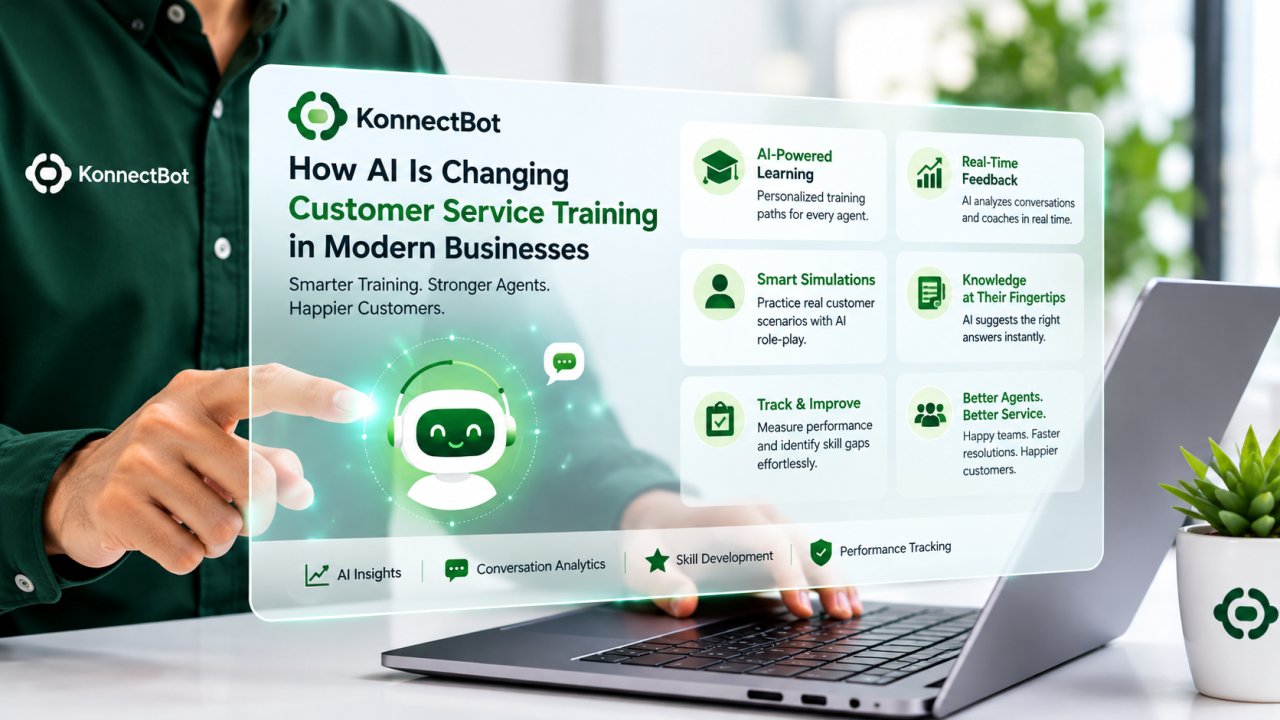
Instead of static training methods, businesses now use AI-powered systems that guide agents in real time, analyze conversations, and provide instant feedback.
Customer support platforms like Zendesk, Intercom, and Crisp are already integrating AI tools that support training and coaching workflows.
Now, customer service skills are not just taught once—they are continuously learned on the job.
What Does Teaching Customer Service Skills Mean Today?
Teaching customer service skills means training support agents to:
-
Communicate clearly with customers
-
Solve problems efficiently
-
Handle complaints professionally
-
Follow company policies
-
Use support tools correctly
-
Improve response quality
In the AI era, this process is no longer limited to classrooms or training manuals.
Instead, AI assists agents while they work, turning every conversation into a learning opportunity.
Why Traditional Customer Service Training Is No Longer Enough
Old training systems face several problems:
-
Slow onboarding process
-
Limited hands-on practice
-
Lack of real-time feedback
-
High training costs
-
Inconsistent learning outcomes
Agents often forget training once they start handling real customers because there is no continuous reinforcement.
This gap is where AI plays a major role.
How AI Helps Teach Customer Service Skills
1. Real-Time Coaching During Conversations
AI assistants guide agents while they are actively chatting with customers.
For example, if a customer asks about refunds, AI can instantly:
-
Show refund policy
-
Suggest a proper response
-
Warn about incorrect replies
-
Guide escalation steps
This turns live chats into learning sessions.
2. Smart Reply Suggestions
AI systems analyze customer messages and suggest responses.
This helps agents:
-
Learn communication patterns
-
Improve writing skills
-
Respond faster
-
Avoid mistakes
Over time, agents naturally adopt better response styles.
3. Instant Knowledge Access
Instead of searching through documents, agents can ask AI directly:
-
“What is the return policy?”
-
“How do I handle billing issues?”
-
“What should I say to angry customers?”
AI provides immediate answers inside the workflow.
4. Continuous Feedback on Performance
AI tracks agent performance and provides feedback on:
-
Response time
-
Accuracy
-
Tone of communication
-
Customer satisfaction
-
Resolution success
This helps managers identify skill gaps quickly.
5. Learning From Real Conversations
AI systems analyze past conversations to identify:
-
Common customer issues
-
Successful responses
-
Mistakes made by agents
-
Best-performing communication patterns
This creates a continuous learning loop.
How AI Changes Customer Service Skill Development
1. From Static Learning to Active Learning
Traditional training is static. AI makes learning active by embedding it inside real conversations.
Agents learn while doing the job instead of before the job.
2. From One-Time Training to Continuous Coaching
Old systems train agents once during onboarding.
AI provides continuous coaching throughout the entire career of the agent.
3. From Manual Feedback to Automated Insights
Supervisors no longer need to review every conversation manually.
AI highlights:
-
Poor responses
-
Missed opportunities
-
Customer dissatisfaction signals
4. From Guesswork to Data-Driven Learning
AI uses real data from customer interactions to teach better skills.
This makes training more accurate and practical.
Key Customer Service Skills AI Helps Improve
1. Communication Skills
AI helps agents:
-
Write clear responses
-
Use proper tone
-
Avoid confusion
-
Stay professional
2. Problem-Solving Skills
Agents learn how to:
-
Identify customer issues faster
-
Follow structured solutions
-
Escalate properly
3. Emotional Handling
AI helps agents respond better to:
-
Angry customers
-
Frustrated users
-
Refund requests
-
Complaints
4. Product Knowledge
AI provides instant access to product and service details during conversations.
5. Efficiency Skills
Agents learn to:
-
Respond faster
-
Reduce errors
-
Manage multiple chats effectively
AI vs Traditional Customer Service Training
|
Traditional Training |
AI-Powered Training |
|
Classroom-based learning |
Real-time learning |
|
Static manuals |
Dynamic AI assistance |
|
Slow onboarding |
Fast skill development |
|
Limited feedback |
Continuous feedback |
|
Supervisor dependency |
AI-driven guidance |
|
One-time training |
Ongoing coaching |
How AI Chat Widgets Support Skill Development
AI chat widgets are not only customer-facing tools. They also act as internal training assistants.
They help agents by:
-
Suggesting replies
-
Explaining policies
-
Guiding workflows
-
Preventing mistakes
-
Improving tone and clarity
This makes every chat a learning experience.
Role of AI in Reducing Training Costs
AI reduces the need for:
-
Long training sessions
-
Repeated workshops
-
Large onboarding teams
-
Manual supervision
Businesses save time and money while improving training quality.
How Businesses Use AI for Customer Service Training
1. E-commerce Support Teams
Agents learn:
-
Order tracking handling
-
Return processing
-
Shipping issues
-
Payment support
2. SaaS Companies
Agents learn:
-
Subscription handling
-
Technical troubleshooting
-
Feature explanation
3. Service Businesses
Agents learn:
-
Appointment handling
-
Client communication
-
Billing support
4. Global Teams
AI helps train multilingual agents using live translation support.
Challenges in AI-Based Training
Even with AI, businesses must manage:
-
Incorrect AI suggestions
-
Outdated knowledge base
-
Over-dependence on automation
-
Need for human supervision
AI works best when combined with human oversight.
Best Practices for Teaching Customer Service Skills Using AI
Keep Knowledge Updated
AI must be trained with updated policies and product information.
Monitor AI Suggestions
Supervisors should review AI recommendations regularly.
Combine AI With Human Coaching
AI should support trainers, not replace them completely.
Encourage Active Learning
Agents should ask questions and interact with AI frequently.
Future of Customer Service Training With AI
AI will continue improving training through:
-
Personalized learning paths
-
Predictive coaching
-
Voice-based training assistants
-
Simulation-based practice
-
Real-time behavioral analysis
Customer service training will become more adaptive and continuous.
FAQs
How does AI help teach customer service skills?
AI provides real-time suggestions, feedback, and coaching during live customer interactions.
Is AI replacing customer service trainers?
No. AI supports trainers by improving efficiency, but human guidance is still important.
Can AI improve agent performance?
Yes. AI helps agents respond faster, reduce mistakes, and improve communication quality.
What skills can AI improve in support teams?
AI improves communication, problem-solving, emotional handling, product knowledge, and efficiency.
Do AI chat widgets help with training?
Yes. AI chat widgets act as real-time assistants that guide agents during customer conversations.
Is AI training suitable for small businesses?
Yes. Small businesses benefit from reduced training time and lower operational costs.
What is the biggest benefit of AI training?
The biggest benefit is continuous, real-time skill development during actual customer interactions.
Conclusion
AI is transforming how businesses teach customer service skills. Instead of relying on slow and static training systems, companies now use AI to provide real-time coaching, automated feedback, and continuous learning.
This shift helps businesses:
-
Train agents faster
-
Improve customer experience
-
Reduce operational costs
-
Increase support quality
With AI-powered tools, every customer interaction becomes a learning opportunity.
As customer expectations continue to grow, AI will become a core part of customer service training in modern businesses.