On this page (22)
- What Is AI-Powered Agent Onboarding?
- Why Traditional Agent Onboarding Is Slow
- How Conversational AI Changes Agent Training
- How Conversational AI Works in Agent Onboarding
- Key Benefits of Conversational AI for Agent Onboarding
- Core Features of AI-Powered Agent Onboarding Systems
- AI Knowledge Assistant
- Workflow Guidance
- Smart Reply Suggestions
- Performance Tracking
- Simulation-Based Learning
- How AI Improves Live Agent Performance
- AI vs Traditional Agent Onboarding
- How Businesses Use Conversational AI for Scaling Support Teams
- Integration With Modern Customer Support Platforms
- Role of AI Chat Widgets in Agent Training
- Common Use Cases of AI Agent Onboarding
- Challenges in AI-Based Onboarding
- Best Practices for AI Agent Onboarding
- Use Real Conversation Data
- FAQs
- Conclusion
Customer support teams are growing fast, but onboarding new agents is still slow in many companies. Traditional onboarding depends heavily on manuals, training documents, and human supervisors.
This creates delays in productivity and often leads to inconsistent support quality.
Modern AI systems are changing this process. Instead of relying only on static training material, businesses now use conversational AI to guide, train, and support new agents in real time.
Platforms like Crisp, Zendesk and Intercom have introduced AI-driven workflows that improve onboarding efficiency and reduce training time.
With conversational AI, onboarding becomes interactive, continuous and context-aware.
What Is AI-Powered Agent Onboarding?
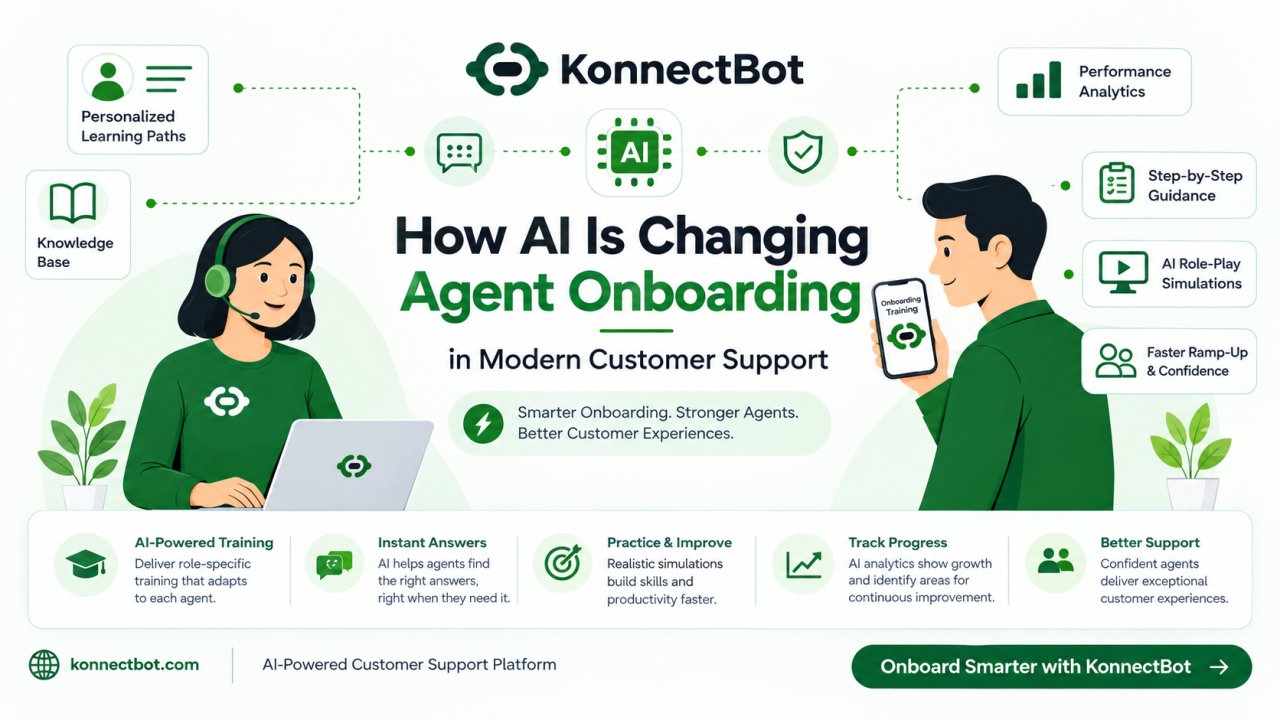
AI-powered agent onboarding is a process where artificial intelligence helps train new customer support agents through interactive conversations, real-time guidance, and automated knowledge assistance.
Instead of reading long documents or attending repetitive training sessions, new agents can learn by:
-
Asking questions to AI assistants
-
Receiving real-time suggestions
-
Following automated workflows
-
Accessing instant knowledge base answers
-
Getting guided responses during live chats
This turns onboarding into a hands-on learning experience.
Why Traditional Agent Onboarding Is Slow
Many companies still rely on outdated onboarding methods such as:
-
PDF training manuals
-
Recorded video sessions
-
Shadowing senior agents
-
Static knowledge bases
-
Classroom-style training
These methods create several problems:
-
Slow learning curve
-
Inconsistent knowledge retention
-
High training costs
-
Delayed productivity
-
Human dependency for every question
New agents often feel overwhelmed during their first weeks.
How Conversational AI Changes Agent Training
Conversational AI introduces real-time learning directly inside the support environment.
Instead of stopping work to search for answers, agents can ask AI during live conversations.
AI assistants help by:
-
Suggesting replies
-
Explaining policies
-
Guiding workflows
-
Recommending actions
-
Reducing mistakes
This makes onboarding continuous instead of one-time training.
How Conversational AI Works in Agent Onboarding
Step 1: Agent Joins the Support System
A new support agent is added to the platform.
They are given access to:
-
Chat dashboard
-
AI assistant
-
Knowledge base
-
Workflow tools
Step 2: AI Starts Guiding the Agent
When the agent opens a conversation, the AI assistant automatically provides:
-
Suggested responses
-
Customer intent analysis
-
Policy explanations
-
Next-step recommendations
This reduces confusion for beginners.
Step 3: Real-Time Learning During Chats
Instead of switching tabs or reading documents, agents learn while working.
For example:
-
If a customer asks about refunds, AI shows refund policy instantly
-
If a customer asks about shipping, AI suggests correct response
-
If escalation is needed, AI guides the process
Step 4: AI Improves Over Time
As agents interact more with customers, AI systems learn:
-
Common questions
-
Agent behavior patterns
-
Response effectiveness
-
Workflow bottlenecks
This improves training quality continuously.
Key Benefits of Conversational AI for Agent Onboarding
1. Faster Training Time
Traditional onboarding can take weeks.
With conversational AI, agents can become productive in days.
AI reduces the need for memorizing large documentation.
2. Real-Time Support During Work
Agents do not need to stop working to find answers.
AI provides instant guidance inside the chat interface.
This reduces hesitation and improves confidence.
3. Reduced Training Costs
Businesses spend less on:
-
Training staff
-
Workshops
-
Manual supervision
-
Repetitive onboarding sessions
AI handles most of the early learning process.
4. Consistent Customer Responses
One major problem in support teams is inconsistency.
Different agents may give different answers to the same question.
AI ensures:
-
Standardized responses
-
Policy accuracy
-
Brand consistency
5. Better Customer Experience
When agents are confident and well-supported, customers receive:
-
Faster replies
-
More accurate answers
-
Better problem resolution
This improves overall customer satisfaction.
Core Features of AI-Powered Agent Onboarding Systems
AI Knowledge Assistant
AI acts as a live knowledge base that agents can interact with.
Instead of searching documents, agents simply ask:
-
“How do I handle a billing issue?”
-
“What should I say to an angry customer?”
AI responds instantly.
Workflow Guidance
AI helps agents follow correct workflows step by step.
For example:
-
Identify customer issue
-
Check account details
-
Apply policy
-
Escalate if needed
This reduces mistakes during onboarding.
Smart Reply Suggestions
AI suggests responses based on customer messages.
This helps new agents:
-
Respond faster
-
Avoid errors
-
Learn communication style
Performance Tracking
AI onboarding systems track agent performance:
-
Response time
-
Accuracy rate
-
Resolution success
-
Customer satisfaction
Managers can identify areas for improvement quickly.
Simulation-Based Learning
Some systems allow agents to practice using AI simulations.
Agents interact with simulated customers and learn how to respond before handling real conversations.
How AI Improves Live Agent Performance
1. Reduces Cognitive Load
New agents do not need to remember everything.
AI provides support in real time, reducing pressure.
2. Helps With Complex Queries
When customers ask difficult questions, AI breaks down the problem and suggests solutions.
3. Prevents Mistakes
AI reduces errors such as:
-
Wrong policy information
-
Incorrect refunds
-
Miscommunication
-
Delayed responses
4. Builds Agent Confidence
New agents feel more confident when AI supports their decisions.
This leads to better customer interactions.
AI vs Traditional Agent Onboarding
|
Traditional Onboarding |
AI Onboarding |
|
Manual training sessions |
Real-time AI guidance |
|
Static documents |
Interactive AI learning |
|
Slow onboarding process |
Fast productivity |
|
High dependency on trainers |
Self-learning system |
|
Inconsistent knowledge |
Standardized responses |
|
Limited feedback loops |
Continuous improvement |
How Businesses Use Conversational AI for Scaling Support Teams
As businesses grow, support teams also expand.
Without AI, scaling becomes expensive and complex.
With conversational AI, businesses can:
-
Onboard new agents faster
-
Maintain consistent support quality
-
Reduce training workload
-
Handle higher ticket volumes
AI becomes a long-term training assistant for the entire team.
Integration With Modern Customer Support Platforms
AI onboarding systems often integrate with:
-
CRM systems
-
Helpdesk tools
-
Knowledge bases
-
Live chat platforms
-
Ticketing systems
Platforms like Zendesk and Intercom are increasingly adding AI features to support onboarding workflows.
Role of AI Chat Widgets in Agent Training
AI chat widgets are not only for customers—they also support internal teams.
They help agents by:
-
Explaining customer issues
-
Suggesting responses
-
Providing policy guidance
-
Automating repetitive tasks
This turns chat widgets into training tools.
Common Use Cases of AI Agent Onboarding
1. E-commerce Support Teams
Agents learn how to handle:
-
Order tracking
-
Returns
-
Shipping issues
-
Payment problems
2. SaaS Customer Support
Agents learn:
-
Subscription management
-
Technical troubleshooting
-
Feature explanations
3. Service-Based Businesses
Agents handle:
-
Appointment scheduling
-
Client communication
-
Billing questions
4. Global Support Teams
AI helps multilingual onboarding with live translation and guidance.
Challenges in AI-Based Onboarding
Even with AI, businesses must manage:
-
Data accuracy
-
Outdated policies
-
Over-reliance on AI
-
Integration complexity
AI works best when combined with human supervision.
Best Practices for AI Agent Onboarding
Keep Knowledge Base Updated
AI is only as good as its data.
Monitor AI Suggestions
Supervisors should review AI recommendations regularly.
Combine AI With Human Training
AI should support trainers, not replace them completely.
Use Real Conversation Data
Training improves when AI learns from real customer interactions.
Future of AI in Agent Onboarding
AI onboarding will continue evolving into:
-
Fully automated training systems
-
Voice-guided onboarding
-
Real-time performance coaching
-
Predictive training suggestions
-
Personalized learning paths
Support teams will become faster and more efficient over time.
FAQs
What is conversational AI in agent onboarding?
It is an AI system that helps train and guide customer support agents in real time during their work.
How does AI help new support agents?
AI provides suggestions, answers policy questions, and guides workflows during live customer conversations.
Does AI replace human trainers?
No. AI supports trainers by reducing workload, but human supervision is still important.
Can AI improve onboarding speed?
Yes. AI reduces training time significantly by offering real-time learning.
What tools use AI for onboarding?
Platforms like Crisp, Zendesk, and Intercom use AI to improve onboarding workflows.
Is AI onboarding suitable for small businesses?
Yes. Small businesses can use AI to reduce training costs and improve efficiency.
What is the main benefit of AI onboarding?
The main benefit is faster, more consistent, and real-time training for customer support agents.
Conclusion
Conversational AI is changing how businesses train and onboard customer support agents. Instead of slow, manual training systems, companies can now use AI to guide agents in real time.